This assembled architecture is a draft adaptation of the repository’s existing artifacts into the architecture-knowledge-toolkit structure. It treats local files as evidence and records uncertain claims as open questions or proposed architecture artifacts.
1. Introduction And Goals
docs-toolbox is a lightweight Docker image for running Docs-as-Code pipelines
in a reproducible environment locally and in CI.
Within the Docs-as-Code Toolkit it provides the runtime layer for rendering. It can support direct Asciidoctor/Pandoc/Gradle builds and can also be combined with higher-level publishing workflows such as docToolchain when a consuming project chooses that path.
1.1. Quality Goals
The top-level quality goals are derived from README.md,
.github/workflows/create-docs-toolbox-image.yml, and Dockerfile.
| Priority | Goal | Evidence |
|---|---|---|
1 |
Reproducible documentation builds across local and CI environments. |
README states the image is for reproducible Docs-as-Code pipelines. |
2 |
Fast contributor onboarding with zero local toolchain setup. |
README emphasizes zero-setup onboarding and avoiding random local installs. |
3 |
Consistent CI execution through a published container image. |
GitHub Actions example uses the image as a job container. |
4 |
Traceable image publication. |
Workflow publishes a Dockerfile-hash tag and tag-based aliases. |
1.2. Requirements Overview
| ID | Requirement | Evidence |
|---|---|---|
REQ-001 |
The repository shall build a Docker image named |
Dockerfile and workflow image name step. |
REQ-002 |
The image shall include Asciidoctor, Asciidoctor Diagram, Asciidoctor reveal.js, Pandoc, Graphviz, unzip, curl, and Python 3. |
Dockerfile package and gem installation. |
REQ-003 |
The image shall allow callers to run arbitrary commands. |
Dockerfile uses an empty |
REQ-004 |
The release workflow shall publish multi-platform images to GHCR. |
Workflow uses Docker Buildx with |
REQ-005 |
The workflow shall publish a Dockerfile-hash tag for every build on |
Workflow computes |
REQ-006 |
The repository shall build architecture documentation HTML without Gradle, including rendered PlantUML diagrams. |
|
REQ-007 |
Pull requests shall validate architecture documentation. |
|
REQ-008 |
Pushes to |
|
REQ-009 |
The image shall expose |
Dockerfile gem installation and README usage example. |
REQ-010 |
The repository shall provide a docToolchain showcase that verifies HTML and PDF generation from the toolkit-compatible architecture sources. |
|
REQ-011 |
The image shall expose |
Dockerfile script installation and README usage example. |
The list is incomplete until maintainers confirm which README claims are part of the supported contract.
1.3. Stakeholders
| Stakeholder | Interest | Evidence |
|---|---|---|
Documentation contributors |
Run documentation builds without local setup. |
README local Docker usage. |
CI maintainers |
Use one consistent toolchain image in workflows. |
README GitHub Actions example. |
Project maintainers |
Publish traceable and reusable image versions. |
GHCR workflow with hash and Git tags. |
Downstream Docs-as-Code projects |
Build AsciiDoc, Markdown, diagram, and document outputs. |
README typical use cases. |
2. Architecture Constraints
The current constraints are derived from the existing Dockerfile, workflow, and license files.
2.1. Toolbox Constraints
| Constraint | Description | Evidence |
|---|---|---|
Container delivery |
The supported toolchain is packaged as an OCI/Docker image. |
README and Dockerfile. |
Base image |
The current base is |
Dockerfile |
Installed packages |
Tools are installed with |
Dockerfile package installation. |
GHCR publication |
Images are published to |
Workflow |
Multi-platform build |
Workflow builds |
Workflow |
MIT license |
Use and distribution follow MIT license terms. |
|
Open constraints are recorded in Questions And Answers.
3. System Scope And Context
3.1. Business Context
The system boundary is the docs-toolbox container image and its publication
workflow. It contains the installed documentation toolchain and OCI metadata.
Projects using the image, GitHub Actions runners, GHCR, and contributor
workstations are external actors or systems.

3.2. Technical Context
| Interface | Partner | Description |
|---|---|---|
Docker build context |
Docker Buildx |
The workflow builds the repository root using |
GHCR registry API |
GHCR |
The workflow authenticates and pushes built images. |
Container command execution |
Docker or CI runtime |
Callers mount a workspace and run documentation commands inside the image. |
README marker block |
GitHub Actions shell step |
The workflow extracts package description metadata from README markers. |
Publishing workflow |
Downstream project, docToolchain, or similar tools |
The image provides a reproducible runtime layer; consuming projects own the publishing workflow choice. |
4. Solution Strategy
The solution strategy is to publish one versioned OCI image that contains the documentation toolchain needed by downstream Docs-as-Code projects.
4.1. Strategy Overview
The current architecture uses a container image as the distribution unit for the Docs-as-Code toolchain. Build and publication are automated with GitHub Actions.
| Strategy | Rationale | Evidence |
|---|---|---|
Containerize the toolchain |
Avoid host setup and CI drift. |
README philosophy and Dockerfile. |
Keep entrypoint empty |
Let consumers run arbitrary documentation commands. |
Dockerfile |
Publish traceable tags |
Help users choose deterministic image references. |
Workflow |
Reuse README marker text |
Keep package description close to product documentation. |
Workflow README extraction step. |
Verify publisher compatibility with a showcase |
Prove that toolkit-compatible architecture sources can still be published by docToolchain. |
|
5. Building Block View
5.1. Level 1 Building Blocks
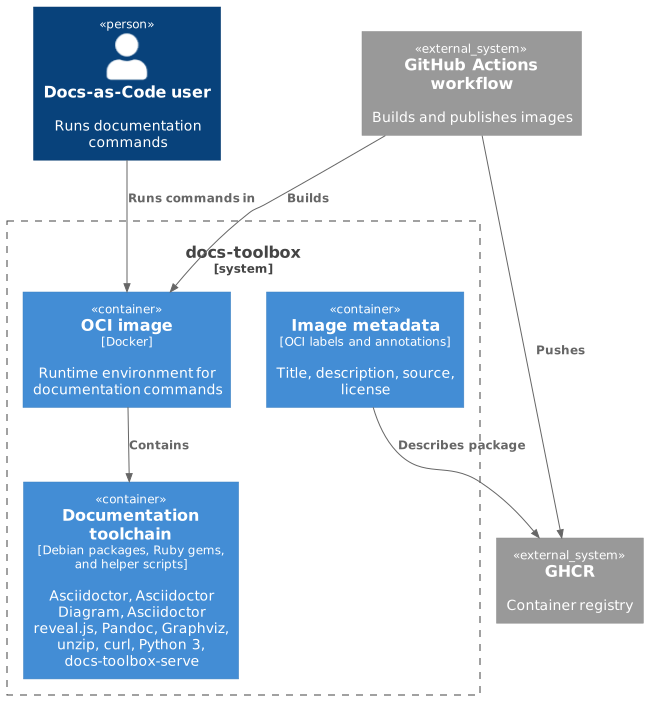
| Building Block | Responsibility | Interface | Storage Location |
|---|---|---|---|
OCI image |
Provide a runnable documentation toolbox environment. |
Docker image command execution. |
Built from |
Documentation toolchain |
Provide Asciidoctor, Asciidoctor Diagram, Asciidoctor reveal.js, Pandoc, Graphviz, unzip, curl, Python 3, and |
CLI commands, Asciidoctor Ruby extensions, and helper scripts inside the image. |
Installed by |
Build workflow |
Build, tag, and push the image. |
GitHub Actions workflow dispatch, push, and tag events. |
|
README description marker |
Provide package description metadata. |
Marker block parsed by workflow shell step. |
|
6. Runtime View
6.1. Local Usage Runtime Scenario
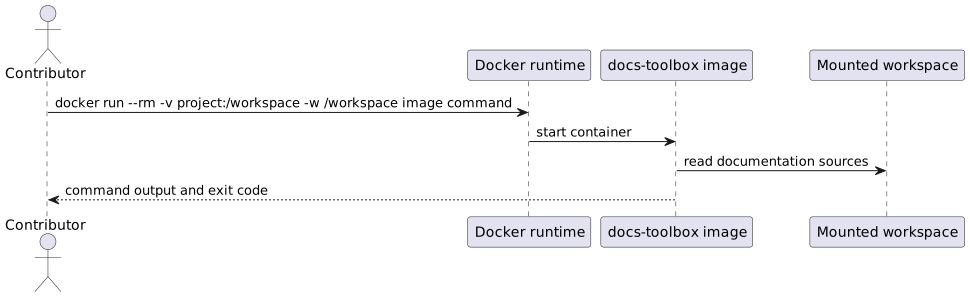
The README example runs asciidoctor -v in the toolbox container.
6.1.1. Architecture Documentation Build
For this repository itself, ./build.sh build validates architecture metadata,
generates derived fragments, and renders src/docs/doc-001-arc42.adoc to
build/architecture/index.html with Asciidoctor and asciidoctor-diagram.
Generated diagram assets are written beside the HTML output.
This is intentional dogfooding: the architecture documentation for the toolbox is generated with the toolbox image itself whenever a container engine is available.
The script first computes the local Dockerfile hash and tries to pull
ghcr.io/docs-as-code-toolkit/docs-toolbox:df-<hash>. If that image is not
available, the script builds a local image from the current Dockerfile before
running the documentation build. This keeps local Dockerfile changes visible to
the build without requiring Gradle.
Gradle projects can still use AsciidoctorJ inside the same toolbox image. This repository’s direct CLI build uses the Ruby Asciidoctor path.
6.1.2. docToolchain Showcase
The showcase/doctoolchain workflow validates that the same architecture
sources can also be consumed by docToolchain. It runs the toolkit metamodel
validator and generators first, then renders the assembled architecture document
with dtcw generateHTML and dtcw generatePDF.
The default showcase path uses dtcw local and installs the configured
docToolchain version under $HOME/.doctoolchain when necessary. The same script
also supports dtcw docker for environments where the docToolchain container is
available.
6.2. Image Publication Runtime Scenario
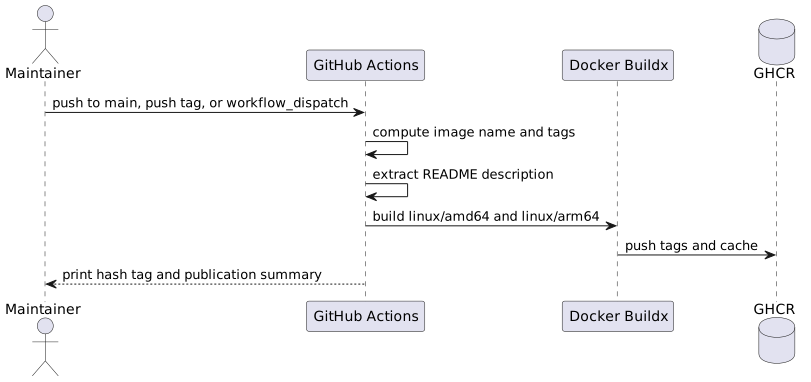
6.3. Failure And Recovery Runtime Scenario
| Failure | Observed Effect | Recovery Candidate |
|---|---|---|
GHCR authentication fails |
Workflow cannot push images. |
Verify |
Package installation fails |
Docker build fails during |
Re-run after upstream recovery or pin/update affected package source. |
Tool command missing in image |
Downstream documentation command fails. |
Add a smoke test and update Dockerfile if the tool is supported. |
README marker missing |
Workflow uses fallback description. |
Restore marker block or accept fallback behavior. |
7. Deployment View
7.1. Local And CI Deployment
| Environment | Deployment Form | Notes |
|---|---|---|
Contributor workstation |
Docker container run with mounted workspace. |
README uses |
GitHub Actions runner |
Job container or image build environment. |
README shows the image as a job container; workflow builds with Buildx. |
GHCR |
Published multi-platform image. |
Workflow pushes |
Downstream CI |
Pinned image reference. |
README recommends pinning versions for determinism. |
GitHub Pages |
Static architecture HTML generated from |
|
docToolchain showcase |
Local or containerized |
|
8. Crosscutting Concepts
8.1. Threat Model
| ID | STRIDE | Threat | Mitigation Candidate |
|---|---|---|---|
T-001 |
Tampering |
Published image contents may not match maintainer intent. |
Build from repository source in GitHub Actions and publish traceable tags. |
T-002 |
Spoofing |
Unauthorized actor may push to GHCR if credentials are misused. |
Limit |
T-003 |
Information disclosure |
Workflow logs may expose sensitive token handling if commands change. |
Keep token use through |
T-004 |
Denial of service |
Upstream package or registry outage may block image publication. |
Retry after outage and consider package pinning/mirroring policy. |
8.2. Security
Current evidence:
-
Workflow requests
contents: readandpackages: write. -
GHCR login uses
${{ secrets.GHCR_PAT }}via standard input. -
The Dockerfile removes
/var/lib/apt/lists/*after package installation.
Open security decisions:
-
Whether image signing is required.
-
Whether vulnerability scanning is required before publishing.
-
Whether the GHCR token can be replaced with
GITHUB_TOKENpermissions.
8.3. Testing
No automated tests were found in the repository during this migration.
Proposed smoke tests:
-
Build the Docker image.
-
Run
asciidoctor --version. -
Run
asciidoctor-revealjs --version. -
Run
ruby -e 'require "asciidoctor-diagram"'. -
Run
ruby -e 'require "asciidoctor-diagram/plantuml"'. -
Run
pandoc --version. -
Run
dot -V. -
Run
curl --version. -
Run
unzip -v. -
Render a minimal PlantUML block through
asciidoctor -r asciidoctor-diagram. -
Render a minimal slide deck through
asciidoctor-revealjswith an explicitrevealjsdirvalue.
These tests would turn README claims about available tools into executable evidence.
Current documentation checks:
-
Pull requests run
./build.sh validate. -
The main branch Pages workflow runs
./build.sh build. -
build.sh validaterunsruby scripts/validate-metamodel.rb --generate. -
showcase/doctoolchain/build.sh html localandshowcase/doctoolchain/build.sh pdf localverify that docToolchain can render the toolkit-compatible architecture sources to HTML and PDF.
8.4. Observability
Observable signals currently visible from repository evidence:
-
Docker command exit codes and standard output for local usage.
-
GitHub Actions logs for image name, tags, README description, and summary.
-
GHCR package tags and annotations after a successful build.
No runtime application logs, metrics, traces, or audit trails exist inside the image because the image is a toolbox environment, not a long-running service.
8.5. Error Handling
The workflow shell steps use set -euo pipefail in the tag computation,
description extraction, and build/push steps. This means most command failures
fail the workflow instead of being silently ignored.
The README description extraction step has a fallback description if the marker block is absent or empty. Docker command failures are surfaced through the container process exit code.
9. Architecture Decisions
9.1. ADR Index
| ADR | Title | Status | Notes |
|---|---|---|---|
Containerized Docs Toolchain |
proposed |
Proposes treating the Docker image as the supported distribution unit for the Docs-as-Code toolchain. |
|
GHCR Publication Tags |
proposed |
Proposes documenting Dockerfile-hash, Git tag, and latest tag semantics. |
9.2. Open Questions
| Question | Role | Topic |
|---|---|---|
Architecture |
Is |
|
Architecture |
What smoke tests should verify image readiness? |
|
Architecture |
Should Reveal.js assets be bundled in the toolbox image? |
|
Architecture |
Should docToolchain be installed in the toolbox image? |
|
Product Owner |
Which installed tools are part of the supported contract? |
|
Product Owner |
What tag should users pin for reproducible CI builds? |
|
Product Owner |
Should package versions be pinned inside the Dockerfile? |
9.3. ADR-001: Containerized Docs Toolchain
9.3.1. Status
Proposed.
This ADR is derived from existing repository evidence and requires maintainer review before it becomes accepted architecture truth.
9.3.2. Decision
We propose to treat the docs-toolbox Docker image as the supported
distribution unit for the documentation toolchain.
9.3.3. Context
The README describes the image as the single source of truth for the documentation toolchain. The Dockerfile packages OpenJDK plus documentation tools. The workflow publishes the image to GHCR.
9.3.4. Decision Drivers
-
Reproducible local and CI builds.
-
Low contributor setup effort.
-
Traceable image publication.
9.3.5. Considered Options
Option 1: Containerized Toolbox Image
Package the toolchain as a Docker image.
Option 2: Host Installation Documentation
Document installation commands for each supported host environment.
Option 3: Project-Specific CI Setup
Let every downstream project install tools in its own pipeline.
9.3.6. Pugh Matrix
| Criterion | Container image | Host installation | Project-specific CI |
|---|---|---|---|
Reproducibility |
+1 |
-1 |
-1 |
Contributor onboarding |
+1 |
-1 |
0 |
CI consistency |
+1 |
-1 |
-1 |
Maintenance simplicity |
0 |
-1 |
-1 |
Sum |
3 |
-4 |
-3 |
9.3.7. Consequences
Positive
-
Downstream users can run the same image locally and in CI.
-
Maintainers can publish traceable image tags.
Negative
-
Image rebuilds may drift if upstream package versions change.
-
Users need Docker or a compatible container runtime.
Neutral or Follow-Up
-
Maintainers should decide whether package versions need explicit pinning.
9.4. ADR-002: GHCR Publication Tags
9.4.1. Status
Proposed.
9.4.2. Decision
We propose to document the current publication tag behavior as an explicit architecture and user contract after maintainer review.
9.4.3. Context
The workflow always computes a Dockerfile hash tag df-<hash>. If the commit
has a Git tag, it also publishes the Git tag and latest.
9.4.4. Decision Drivers
-
Deterministic downstream CI configuration.
-
Clear release communication.
-
Compatibility with the existing workflow.
9.4.5. Considered Options
Option 1: Current Tag Set
Use Dockerfile hash tags for all builds and Git tag plus latest for tagged
commits.
Option 2: Git Tags Only
Publish only human release tags.
Option 3: Latest Only
Publish only latest.
9.4.6. Pugh Matrix
| Criterion | Current tag set | Git tags only | Latest only |
|---|---|---|---|
Traceability |
+1 |
0 |
-1 |
User simplicity |
0 |
+1 |
+1 |
Reproducibility |
+1 |
+1 |
-1 |
Workflow fit |
+1 |
0 |
-1 |
Sum |
3 |
2 |
-2 |
9.4.7. Consequences
Positive
-
Users can choose between hash-based traceability and release tags.
Negative
-
README guidance must explain when
latestis published and why pinning is preferred.
9.5. ADR Candidates
The migration found the following decision candidates:
-
Whether
openjdk:22-jdk-slimis the long-term base image. -
Whether Debian package versions should be pinned.
-
Whether
GHCR_PATshould remain the registry authentication mechanism. -
Whether image signing or vulnerability scanning is required before publishing.
-
Whether GitHub Pages is the long-term publication channel for architecture documentation.
-
Whether Reveal.js frontend assets should be bundled in the toolbox image or supplied by downstream projects through
revealjsdir. -
Whether docToolchain support should remain a repository-local showcase, move into a dedicated showcase repository, or become a preinstalled variant of the docs-toolbox image.
10. Quality Requirements
10.1. Quality Scenarios
| ID | Objective | Source | Stimulus | Artifact | Environment | Response | Response measure |
|---|---|---|---|---|---|---|---|
Documentation contributor or CI pipeline |
Runs a documentation build using the same pinned |
Containerized documentation toolchain |
Local workstation and GitHub Actions runner |
The same documented tools are available in both environments |
All supported tool smoke-test commands pass in both environments for the same image reference |
||
Downstream project pipeline |
Starts the image and calls a documented CLI tool |
Installed packages inside |
Normal CI execution |
The command exists and returns version or help output |
|
||
Maintainer |
Inspects a published image tag after workflow completion |
GHCR image tags and annotations |
Successful GitHub Actions build on |
The image has a Dockerfile-hash tag and source annotation; tagged commits also publish Git tag and |
Workflow summary prints the Dockerfile hash tag on every successful run and prints the Git tag when present |
10.2. Quality Tree
-
Reproducibility
-
Usability
-
Maintainability
-
Candidate: automated smoke tests for all supported tools.
-
10.3. QS-001: Reproducible Toolchain
10.3.1. Status
Proposed.
10.3.2. Scenario
| Element | Description |
|---|---|
Source |
Documentation contributor or CI pipeline. |
Stimulus |
Runs a documentation build using the same pinned |
Environment |
Local workstation and GitHub Actions runner. |
Artifact |
Containerized documentation toolchain. |
Response |
The same documented tools are available in both environments. |
Response Measure |
All supported tool smoke-test commands pass in both environments for the same image reference. |
10.3.3. Assumptions
-
The exact supported smoke-test command list requires maintainer confirmation.
10.4. QS-002: Toolchain Availability
10.4.1. Status
Proposed.
10.4.2. Scenario
| Element | Description |
|---|---|
Source |
Downstream project pipeline. |
Stimulus |
Starts the image and calls a documented CLI tool. |
Environment |
Normal CI execution. |
Artifact |
Installed packages inside |
Response |
The command exists and returns version or help output. |
Response Measure |
|
10.4.3. Assumptions
-
The command names should be confirmed against the actual image entrypoint and package paths.
-
A minimal diagram rendering smoke test should confirm the Asciidoctor CLI path.
-
A minimal slide rendering smoke test should confirm the Asciidoctor reveal.js CLI path and explicit
revealjsdirhandling. -
A static web server smoke test should confirm that
docs-toolbox-serve --helpworks and that the command serves a generated presentation directory.
10.5. QS-003: Publication Traceability
10.5.1. Status
Proposed.
10.5.2. Scenario
| Element | Description |
|---|---|
Source |
Maintainer. |
Stimulus |
Inspects a published image tag after workflow completion. |
Environment |
Successful GitHub Actions build on |
Artifact |
GHCR image tags and annotations. |
Response |
The image has a Dockerfile-hash tag and source annotation; tagged commits also publish Git tag and |
Response Measure |
Workflow summary prints the Dockerfile hash tag on every successful run and prints the Git tag when present. |
10.5.3. Assumptions
-
Maintainers should confirm whether source annotations are sufficient traceability or whether commit SHA labels are required.
11. Risks And Technical Debt
11.1. Risks
| ID | Risk | Probability | Impact | Priority | Mitigation/action |
|---|---|---|---|---|---|
Unpinned Package Versions |
Medium |
Medium |
Medium |
||
Registry Publication Credentials |
Low |
High |
Medium |
||
Ambiguous Latest Tag |
Medium |
Medium |
Medium |
11.2. Technical Debt
| ID | Debt Candidate | Affected Building Block |
|---|---|---|
TD-001 |
No automated smoke tests currently prove that the image contains every documented tool. |
Documentation toolchain. |
TD-003 |
Package version support policy is not recorded. |
Dockerfile and publication workflow. |
11.3. RISK-001: Unpinned Package Versions
11.3.1. Status
Proposed.
11.3.2. Risk Statement
Because the Dockerfile installs packages from distribution repositories without explicit package version pins, future image rebuilds may contain different tool versions, leading to unexpected documentation build differences.
11.3.3. Assessment
| Field | Value |
|---|---|
Likelihood |
Medium. |
Impact |
Medium. |
Priority |
Medium. |
Timeframe |
Medium-term. |
Confidence |
Medium. |
11.3.4. Mitigation Options
-
Decide whether package pinning is required.
-
Add smoke tests and publish tested image references.
-
Document recommended tag pinning for downstream CI.
11.4. RISK-002: Registry Publication Credentials
11.4.1. Status
Proposed.
11.4.2. Risk Statement
Because the workflow authenticates to GHCR using GHCR_PAT, token
misconfiguration or exposure may prevent image publication or allow unintended
package writes.
11.4.3. Assessment
| Field | Value |
|---|---|
Likelihood |
Low. |
Impact |
High. |
Priority |
Medium. |
Timeframe |
Near-term. |
Confidence |
Medium. |
11.4.4. Mitigation Options
-
Keep workflow permissions minimal.
-
Review whether
GITHUB_TOKENcan replace the PAT. -
Rotate the token if exposure is suspected.
11.5. RISK-003: Ambiguous Latest Tag
11.5.1. Status
Proposed.
11.5.2. Risk Statement
Because latest is a moving tag and is published for tagged commits, downstream
users may pin latest in CI and lose reproducibility across time.
11.5.3. Assessment
| Field | Value |
|---|---|
Likelihood |
Medium. |
Impact |
Medium. |
Priority |
Medium. |
Timeframe |
Near-term. |
Confidence |
Medium. |
11.5.4. Mitigation Options
-
Document recommended pinning behavior.
-
Prefer Git tag or Dockerfile hash references in CI examples.
-
Clarify when
latestis published.
12. Glossary
12.1. Terms
| Term | Meaning |
|---|---|
Docs-as-Code |
Treating documentation sources, reviews, builds, and publishing as code-like versioned workflows. |
docs-toolbox |
The container image built by this repository for documentation pipelines. |
GHCR |
GitHub Container Registry, the publication target used by the workflow. |
Dockerfile hash tag |
Image tag of the form |
Asciidoctor reveal.js |
Converter that turns AsciiDoc slide sources into Reveal.js HTML presentations. |
Supported tool |
A CLI tool that maintainers confirm as part of the image contract. |
13. Appendix
13.1. Questions And Answers
This document records open questions and assumptions discovered while adapting existing repository artifacts into the toolkit documentation structure.
13.1.1. Open Questions For Product Owner
Q-PO-001: Which installed tools are part of the supported contract?
Answer: Open.
Evidence currently shows Asciidoctor, Asciidoctor Diagram, Asciidoctor
reveal.js, Pandoc, Graphviz, unzip, curl, Python 3, OpenJDK, and the
docs-toolbox-serve helper in the Dockerfile. It is not yet reviewed whether
all of them are long-term supported features or implementation conveniences.
Q-PO-002: What tag should users pin for reproducible CI builds?
Answer: Open.
The workflow publishes df-<hash> tags and, on Git-tagged commits, the Git tag
and latest. Maintainers should confirm recommended user guidance.
Q-PO-003: Should package versions be pinned inside the Dockerfile?
Answer: Open.
The current Dockerfile installs packages from the base distribution repositories without explicit package version pins.
13.1.2. Open Questions For Architecture
Q-ARCH-001: Is openjdk:22-jdk-slim the intentional long-term base?
Answer: Open.
The Dockerfile uses this base image. The architectural rationale and update policy are not recorded yet.
Q-ARCH-002: What smoke tests should verify image readiness?
Answer: Open.
No automated tests were found in this repository. A candidate is verifying the version command for each supported CLI tool.
Q-ARCH-003: Should Reveal.js assets be bundled in the toolbox image?
Answer: Open.
The image now provides the asciidoctor-revealjs converter. Slide rendering
still needs a revealjsdir value that points to CDN-hosted, vendored, or local
Reveal.js frontend assets.
Q-ARCH-004: Should docToolchain be installed in the toolbox image?
Answer: Open.
Current assumption: docs-toolbox should first stay a lightweight,
reproducible runtime for the tools already used by the project: Asciidoctor,
Asciidoctor Diagram, Pandoc, Graphviz, and Java/Gradle-based builds. This does
not compete with docToolchain. docToolchain can
remain a higher-level publishing workflow that consumes structured AsciiDoc
sources, while docs-toolbox provides local and CI rendering support. Installing
docToolchain in the image should be a deliberate product decision, not an
implicit dependency.
13.2. Traceability Matrix
| Artifact ID | Type | Title | Status | Outgoing relations | Incoming relations |
|---|---|---|---|---|---|
ADR |
Containerized Docs Toolchain |
proposed |
addresses → QS-001-reproducible-toolchain |
DOC-02001-toolbox-constraints → constrains |
|
ADR |
GHCR Publication Tags |
proposed |
addresses → QS-003-publication-traceability |
- |
|
Document |
docs-toolbox Architecture |
draft |
documents → DOC-01000-introduction-and-goals |
- |
|
Document |
Introduction And Goals |
draft |
- |
DOC-001-arc42 → documents |
|
Document |
Quality Goals |
draft |
refines → DOC-01000-introduction-and-goals |
QS-001-reproducible-toolchain → refines |
|
Document |
Requirements Overview |
draft |
refines → DOC-01000-introduction-and-goals |
- |
|
Document |
Stakeholders |
draft |
refines → DOC-01000-introduction-and-goals |
- |
|
Document |
Architecture Constraints |
draft |
- |
DOC-001-arc42 → documents |
|
Document |
Toolbox Constraints |
draft |
constrains → ADR-001-containerized-docs-toolchain |
- |
|
Document |
System Scope And Context |
draft |
- |
DOC-001-arc42 → documents |
|
Document |
Business Context |
draft |
refines → DOC-03000-system-scope-and-context |
- |
|
Document |
Technical Context |
draft |
refines → DOC-03000-system-scope-and-context |
- |
|
Document |
Solution Strategy |
draft |
- |
DOC-001-arc42 → documents |
|
Document |
Strategy Overview |
draft |
addresses → QS-001-reproducible-toolchain |
- |
|
Document |
Building Block View |
draft |
- |
DOC-001-arc42 → documents |
|
Document |
Level 1 Building Blocks |
draft |
affects → QS-002-toolchain-availability |
- |
|
Document |
Runtime View |
draft |
- |
DOC-001-arc42 → documents |
|
Document |
Local Usage Runtime Scenario |
draft |
addresses → QS-001-reproducible-toolchain |
- |
|
Document |
Image Publication Runtime Scenario |
draft |
addresses → QS-003-publication-traceability |
- |
|
Document |
Failure And Recovery Runtime Scenario |
draft |
affects → RISK-001-unpinned-package-versions |
- |
|
Document |
Deployment View |
draft |
- |
DOC-001-arc42 → documents |
|
Document |
Local And CI Deployment |
draft |
refines → DOC-07000-deployment-view |
- |
|
Document |
Crosscutting Concepts |
draft |
- |
DOC-001-arc42 → documents |
|
Document |
Threat Model |
draft |
refines → DOC-08000-crosscutting-concepts |
- |
|
Document |
Security |
draft |
mitigates → RISK-002-registry-publication-credentials |
- |
|
Document |
Testing |
draft |
refines → DOC-08000-crosscutting-concepts |
- |
|
Document |
Observability |
draft |
refines → DOC-08000-crosscutting-concepts |
- |
|
Document |
Error Handling |
draft |
refines → DOC-08000-crosscutting-concepts |
- |
|
Document |
Architecture Decisions |
draft |
- |
DOC-001-arc42 → documents |
|
Document |
ADR Candidates |
draft |
refines → DOC-09000-architecture-decisions |
- |
|
Document |
Quality Requirements |
draft |
- |
DOC-001-arc42 → documents |
|
Document |
Quality Tree |
draft |
refines → DOC-10000-quality-requirements |
- |
|
Document |
Risks And Technical Debt |
draft |
- |
DOC-001-arc42 → documents |
|
Document |
Technical Debt |
draft |
refines → DOC-11000-risks-and-technical-debt |
- |
|
Document |
Glossary |
draft |
- |
DOC-001-arc42 → documents |
|
Document |
Terms |
draft |
refines → DOC-12000-glossary |
- |
|
Document |
Appendix |
draft |
- |
DOC-001-arc42 → documents |
|
QualityScenario |
Reproducible Toolchain |
proposed |
refines → DOC-01001-quality-goals |
ADR-001-containerized-docs-toolchain → addresses |
|
QualityScenario |
Toolchain Availability |
proposed |
refines → DOC-01001-quality-goals |
DOC-05001-level-1 → affects |
|
QualityScenario |
Publication Traceability |
proposed |
refines → DOC-01001-quality-goals |
ADR-002-ghcr-publication-tags → addresses |
|
Risk |
Unpinned Package Versions |
proposed |
affects → QS-001-reproducible-toolchain |
DOC-06003-failure-recovery → affects |
|
Risk |
Registry Publication Credentials |
proposed |
affects → QS-003-publication-traceability |
DOC-08002-security → mitigates |
|
Risk |
Ambiguous Latest Tag |
proposed |
affects → QS-003-publication-traceability |
ADR-002-ghcr-publication-tags → introduces_risk |